You Didn't Choose the Wrong Man. You Chose the Wrong Role.
You chose him carefully. You felt something real. You saw who he could be.
And somewhere between then and now – something changed.
You are not unhappy in your relationship because you don’t love him – most likely you love him, and that’s exactly what makes this so confusing.

Because somewhere between then and now has changed. The dynamic shifted in a way you can’t quite explain. You suddenly found yourself managing everything,
carrying everything, holding the whole structure of your life together while he seems to drift further into passivity. You lie next to him at night feeling nothing, or worse – feeling resentment you’re ashamed of, and you don’t understand how you got here.
Before you decide it’s him. Before you decide you chose the wrong man. Before you start looking for the exit – Read this.
What I am going to share with you today changed everything for me personally and for the women I work with, because what’s happening in your relationship has very little to do with him and everything to do with a role you’ve been playing since long before you met him.
Who is the man beside you ?
Who is a man for you in a relationship?
Take a moment and answer honestly.
Most women say: Support. Protection.
A leader. Someone who chooses me. Someone I can lean on.
Now look honestly at the relationship you have. Does what you described match what you actually experience every day?

I’m going to guess the answer is no – and that instead of the man you described, you have someone who feels passive, maybe irresponsible, maybe not someone you can lean on, someone you find yourself managing more than partnering with.
And before you conclude that you simply chose the wrong man, I want to break that myth – because he was different at the beginning, wasn’t he?
He showed interest, he made decisions, he did something that made you believe he was the one. You felt his intention, you saw his potential and it looked real then. Right?
Then why did you start questioning yourself – if I chose wrong.
The question is not whether you chose badly, but what happened to the dynamic between you, and why.
It's not him. It's not even you. It's the role.
Carl Jung called it the persona – the social face, the mask we present to the world so we can belong, communicate, survive.
The role is not the enemy, it helped you, it made you functional and capable and strong. And there is nothing wrong with wearing a mask as long as you know it’s only a mask, as long as you can see clearly where the role ends and where you begin.

The problem comes when the role becomes you – when you’ve worn it for so long that you can no longer feel the difference between the mask and the face underneath it – and when this happens inside a relationship, the consequences are slow and quiet and devastating.
Because the role you learned to play in childhood, you brought it with you into your partnership, and it began shaping the dynamic between you without either of you realizing it.
Let me describe the two most common roles I see, and I want you to notice what happens in your body as you read -because the body always knows before the mind catches up.
The Woman-Mother
Not the mother to your children – the mother to your man, which is a role that begins very early in life, usually when a girl learns that love comes through being needed, through caring, through being the one who holds everything together.
Maybe in your family someone was emotionally unavailable, or maybe being strong and mature was what made you feel safer, or maybe you found yourself taking care of someone else while you were still a child yourself.
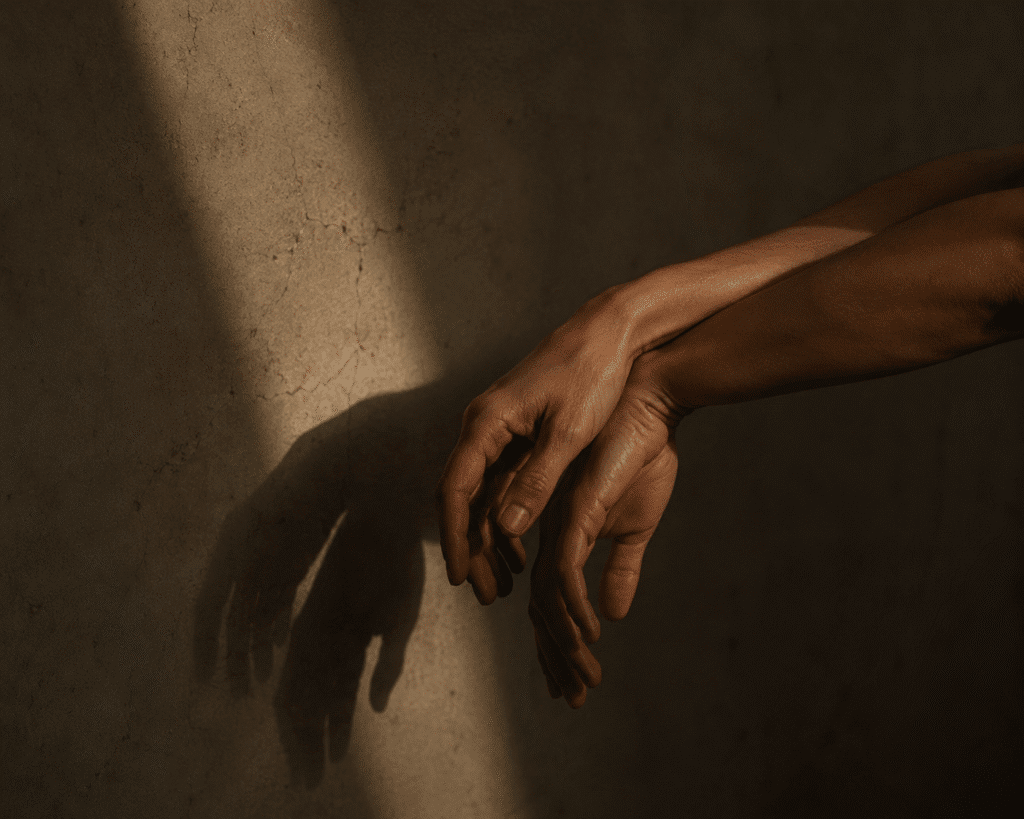
So you stepped up – not because you chose to, but because the program was written in your body before you had the words to describe it.
You became the responsible one, the one who understands, the one who forgives, the one who regulates everyone around her including him.
When you entered this role in your relationship, your partner stepped into the child’s role automatically, because that is how systems work. He started complaining, avoiding responsibility, expecting you to manage things, not because he is weak or broken but because the dynamic you created together left him no room to be anything else.
And meanwhile, something was happening to you that you may not have named yet.
Playing this role was slowly disconnecting you from your own femininity, from your desire, from your sexuality, because you cannot desire someone you are mothering, you cannot surrender to someone you are leading, and so the desire faded.
It did not happen dramatically, but quietly, gradually, until one day you realized you felt nothing when he touched you.

and if you’re reading this and the desire is still there, don’t wait for that day.
I have seen this happening many times, the slow dimming. And what strikes me every time is that women don’t just lose desire passively -they unconsciously start suppressing it, making themselves less attractive, less available, less alive in their own body,
Because a mother is not supposed to be desired.
Stay with this for a moment – notice where you feel it in your body, whether it’s in your chest that learned to stay closed and protected, or in your shoulders that have been carrying so much for so long, or in your jaw that stays tense even when nothing is wrong, or in your belly that somewhere along the way forgot how to soften.
The Woman-Mother
If the Mother says “he can’t without me, I am here for him,” the Woman-Man says
“I will do it instead of him, if I don’t lead nothing moves”
and the difference between these two roles is important to feel.

Mother positions herself above, as a protector and caretaker, while the Woman-Man stands opposite, as a competitor, as someone who leads not from love but from a deep unconscious belief that if she stops controlling, everything will fall apart.
In this role you are not protecting him – you are competing with him, proving your worth, holding the direction, and your body carries all of this whether you are aware of it or not.
Your jaw is tense, your body leans forward, your shoulders pull in, your belly stays held, your pelvis is tucked under, you are always ready to act and almost never in a state of receiving.
What most women in this role don’t realize is that receptiveness is one of the most important feminine qualities – not because of some outdated idea about how women should behave, but because for a man, a woman’s receptiveness means he is needed, it means he has a place, it means he matters.
A woman, who controls every step and manages everything can clearly do it all without him.
He doesn’t feel needed, but instead he feels irritation, a pull to compete, or a complete withdrawal.

He thinks: “you want to lead, then lead, I’ll step back”. There can be sex, but there is no longer any space for real intimacy, because intimacy requires trust and surrender, and this role does not know how to trust, because once, a long time ago, it learned that control equals survival.
This also started in childhood, most likely because there was no strong masculine presence, or because life circumstances forced you into a mode of survival, where softness felt dangerous, where if you lost control you felt like you might disappear.
So at some point you stopped allowing softness, and slowly this became who you believed you were.
And I want to say clearly – I am talking about dynamics with a healthy man, not the one with narcissistic patterns or behavioral dysfunctions, because those are different conversations entirely.
The shadow

Everything that doesn’t fit these roles gets pushed away – your wildness, your unpredictability, your desire, your anger, your instincts, your natural flow – all of it goes into what Jung called the shadow, and the stronger the role, the deeper the shadow goes.
And so sometimes when you are alone, your mind starts going somewhere else – to someone who doesn’t know how responsible you are, how much you carry, how reliable you’ve always been.
Someone who only sees the part of you that you buried in order to become a good partner.
When you catch yourself you feel ashamed, as if something is wrong with you for having these thoughts.
But nothing is wrong with you – that is your shadow asking to be seen. Those are the parts of you that were never allowed inside the role, the parts that went underground because there was no room for them in the version of yourself you had to become.
My client's story
A woman came to me with one sentence – “I don’t want sex, I don’t know why”
and what struck me immediately was not what she said but what she carried in her body when she said it, because she wasn’t angry, she wasn’t confused, she was ashamed, as if something was fundamentally broken in her.
Her partner had his own explanation for it – “frigid”
and she had been quietly carrying that word for so long that somewhere along the way she started to believe it might be true.
We didn’t talk about it the way you might expect – we didn’t sit and analyze her relationship history.
Instead we moved, and what happened in that movement was something her mind had been hiding from her for years, because her body spoke first.
What it said was not that she was broken or cold, but that it had been protecting her, intelligently and consistently, from a dynamic she hadn’t yet been able to see clearly.
She had become his mother -not dramatically, but energetically.
She was carrying everything, managing everything, making sure everything was held together. And her body, which is always smarter than our explanations, simply could not open to someone she was mothering.

We found the pattern together – and something shifted in her. She finally saw what the role had been costing her. That is how she stopped managing and carrying and leading, she didn’t say a word to him, she simply changed the dynamic from the inside.
And he felt it too. Something in him that had been passive for years woke up, not because she asked him to step up or gave him an ultimatum, but because the role changed and he responded.
Can you imagine how powerful inner work could be ?
They still live together as two adults, as partners, and she didn’t need a new man to get there. She just stepped out of the role.
I know this place
I lived in this role for ten years, in a relationship where I had stepped into the responsible one’s position from the very beginning, because he was younger and I told myself he just needed support and time to grow into it.
He did grow, but I never stopped treating him as someone who couldn’t, and I only understood what had actually happened between us years after the relationship ended, when I finally had enough distance to see the pattern clearly
When I left, the grief I felt didn’t resemble losing a partner – it felt like leaving a child, and that feeling, more than anything else, showed me how completely I had lived inside that role, and how much it had cost both of us.
I don’t want that for you, because you still have time, and the pattern can be broken from the inside, without leaving, without losing him, without years of therapy.
The role is not you

Under the role, there is a woman who feels and desires and creates, who knows the taste of life, whose body is soft and whose jaw is relaxed and whose heart is open.
Who feels a warm aliveness in her lower belly when she thinks about her partner, who doesn’t need to manage or control because she trusts herself and trusts him – and she is still there, she has always been there.
She didn’t disappear, she just went underground when the role took over.
You don’t need to fix her – you need to remember her, and the way back to her is not through understanding or analysis or reading more articles.
Because the role doesn’t live in your mind, it lives in your body – in the tension you carry, in the places that forgot how to soften, and that is exactly where the work has to happen.
The way out
I built something for women who recognize themselves in what I’ve described here – a guided body-based experience where you find the pattern not in your thoughts but in your body, where it actually lives.
And you begin to rewrite it, not with affirmations or promises to yourself but through a real somatic experience that gives your nervous system a different option.
And your body receives the new direction.
Not a mindset exercise. Not a conversation about it, but
A guided somatic experience -around 30 minutes, my voice, your body – where you find the pattern not in your thoughts but in your body, where it actually lives, and begin to rewrite it from the inside.
One role. One pattern. One shift – and you’ll never need to return to the role that has been quietly destroying what could be the most alive and intimate relationship of your life.
Just you and my voice, and the body that has been waiting for you to come back to it.
Click the button below. I’ll guide you from there.



